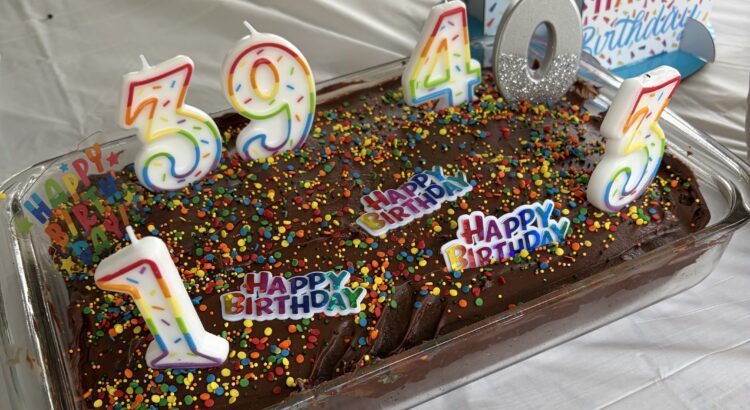
I turned 40 last month. Woohoo!
I mean it… Woohoo!
Getting older fucking rules. Each year I get less stupid and more chill. Each makes life a little easier, more enjoyable bit by bit.
I wasn’t feeling this way a few weeks before My Big Day. Turning 40 is that “over the hill” age. I remember being a kid celebrating an aunt’s 40th birthday, and all the gifts were of the gag variety—a walking cane for her soon to be old and decrepit body, Bengay cream for sore muscles, a guidebook for getting older and irrelevant! This notion that turning 40 means “it’s all downhill from here” is ingrained in me, and despite my felt-joy that each year things get better, the fact that each year I get older and closer to pain—physical and otherwise—wasn’t lost on me.
After all, what does 40-year-old me have to look forward to? The mortality of loved ones and self creeps closer to my purview. I could worry about that a lot if I chose to. I could also worry about my life’s work. What have I done, really? The ticking time bomb of a literal deadline is haunting.
But, alas, the inevitability of it all changed my tune. No use fighting it. So what is there to celebrate? Everything, it turns out.
All there ever is… is everything.
I celebrate looking back on the last decade. I’ve experienced two miracles in my life and they both happened in my thirties.
The first was sobriety. I spent all but one month of the decade stone cold sober and it unlocked everything good that followed. Expansive creativity, true love and friendship, a narcolepsy diagnosis, a depth of adventure and presence that made Chicago feel completely cleansing and invigorating for me, a self respect and social calm, every form of healing. I could go on and on. Sobriety is the once-impossibility that became a lifelong gift that keeps on giving. I cherish it.
The second miracle was one of timing… Doug reaching out to me (after 15+ years of not seeing each other) exactly one week after I told my ex I wanted a divorce. One miracle enabled the other.
I am so endlessly grateful for all the messy, embarrassing, hungry, complicated, wild, accountable “Me”s I have been in the past.
They got me here.
And here is 40.
Where there are new adventures on the horizon and already unfolding.
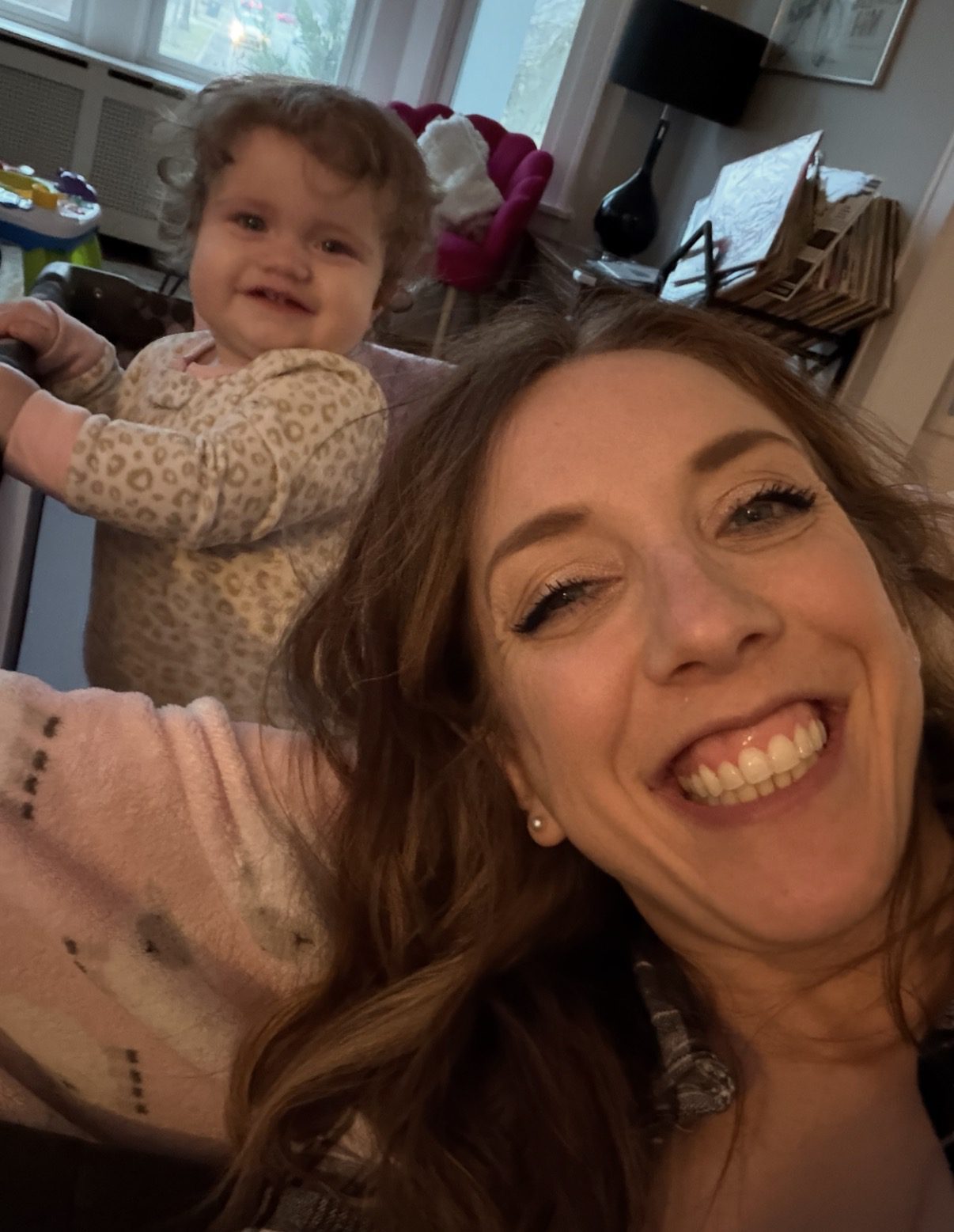
I spent my birthday with Alice. We went to her swim lessons, where we get to swim together and I get to know her more. She is physically strong and her personality is all charisma. I love watching her grow and engage with this world I have helped create for her.
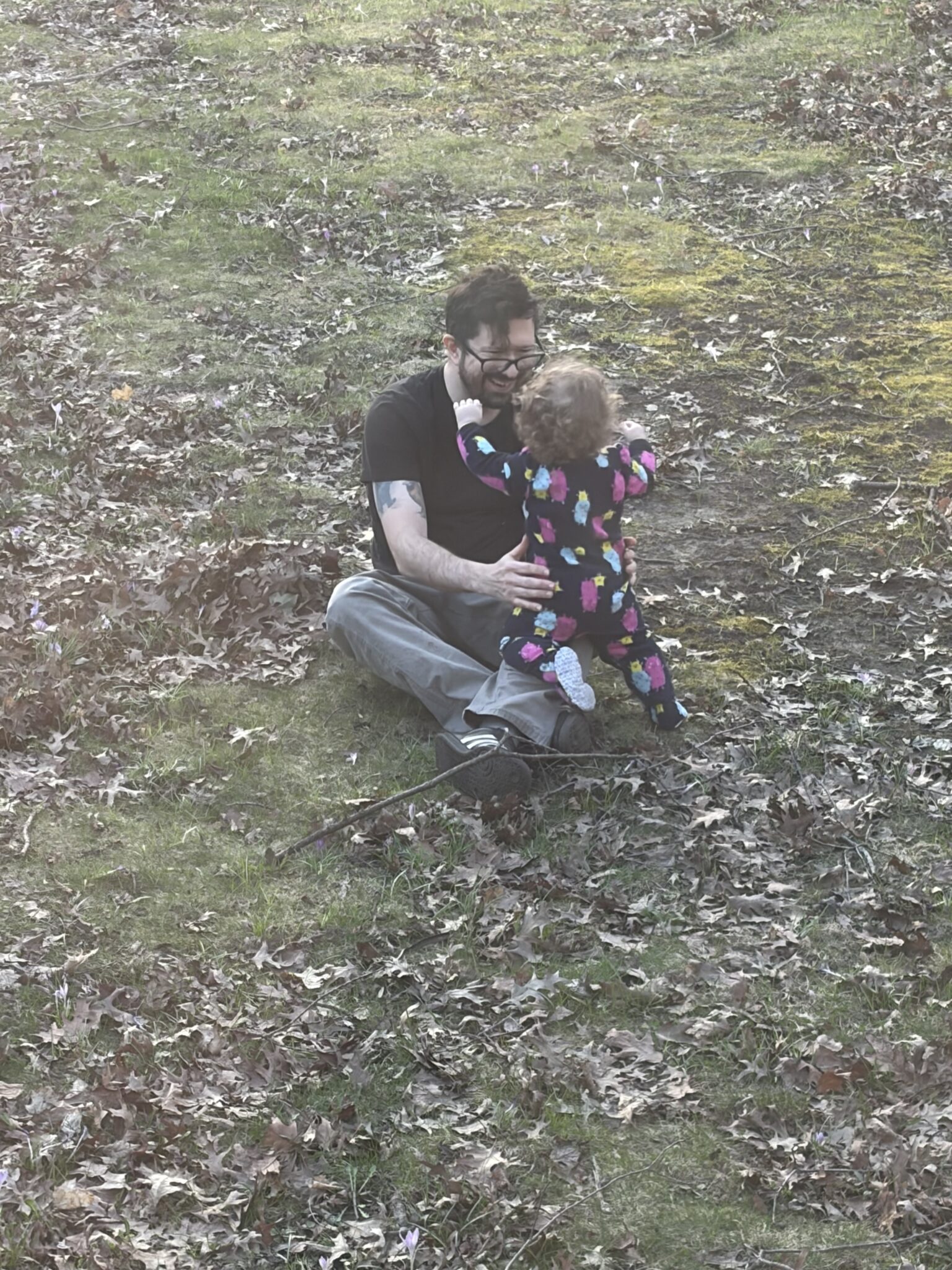
She gave me the ultimate gift: a two-hour nap after lunch and her bath. Then we played outside a bit because it was warm and why not? She crawled around the front lawn, giggling at the purple flowers I picked for her and let her hold in her little hands.
Doug worked most of the day but came home with 8 chicken sandwiches. Yes, 8. I had said all I wanted for my birthday was some alone time and a hot chicken sandwich. I was taking that aforementioned nap when he was placing the order for pickup. He didn’t know which spicy sandwich I wanted so he ended up buying all of them so I could choose.
I mean, if that’s not love, I don’t want whatever is.
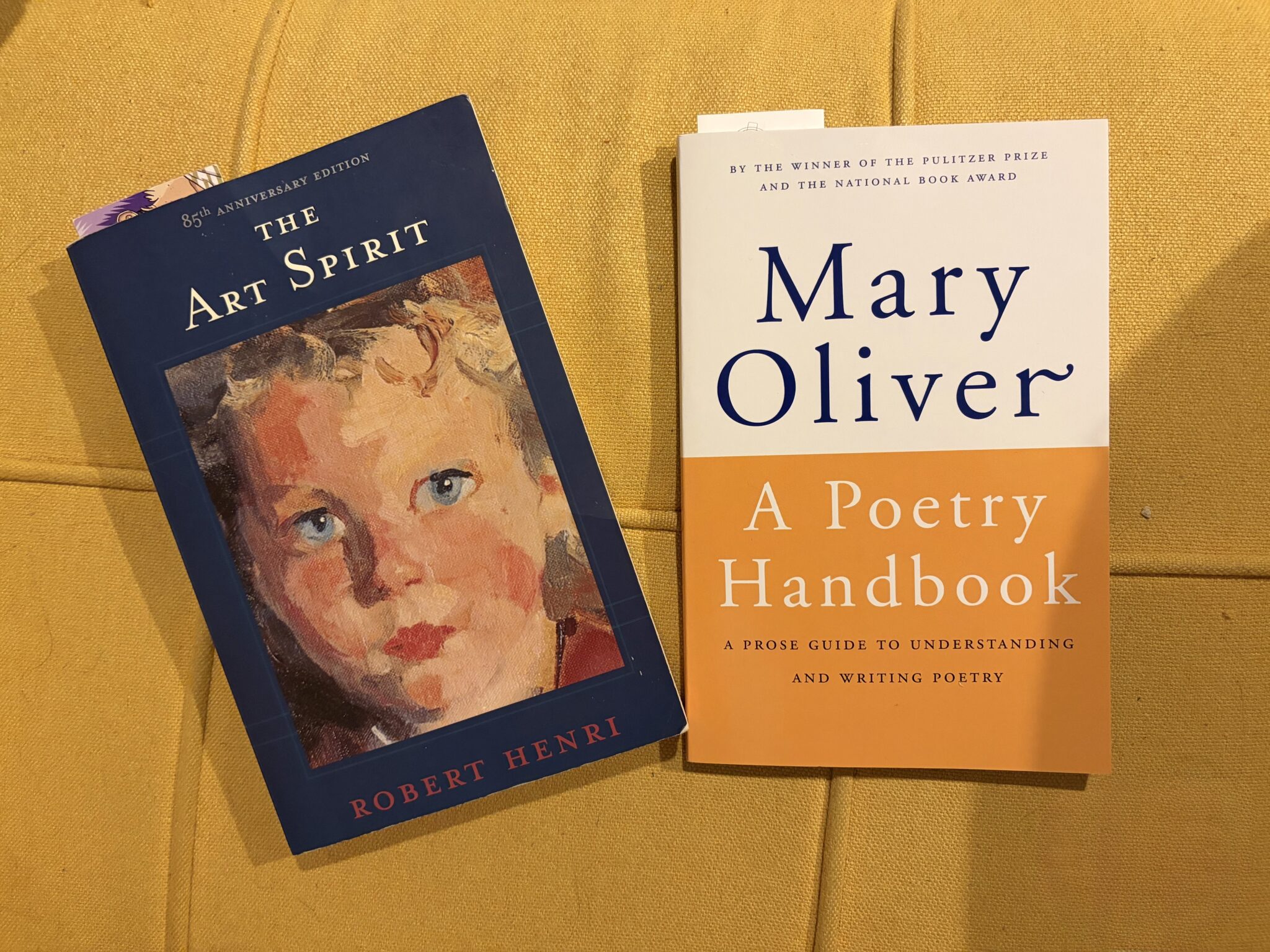
After dinner, I went to my office studio space and read and painted and kind of just putzed around deep in thought. Mmm, listen, that “me time” shit hits extra delicious when you have a toddler. (Almost as good as the two versions of hot chicken sandwiches I ate that evening.)
In the quiet, I picked up a couple books that felt like they’d been waiting for me.
First was Henri Robert’s The Art Spirit. There’s this passage about how the best artists are the ones who can “listen to the song within”—that fleeting, sensitive, almost sacred thing that shows up in moments of presence… and then disappears the second you try to intellectualize it. The passage talks about how rare it is to stay in that state. How most of us drop out of it and go back to being our “ordinary selves.” I know that feeling. I’ve lived my life both ways—disconnected from that inner signal, and deeply tuned into it. Sobriety gave me access to something like that. Motherhood is reshaping it. And 40, I think, is asking me to protect it.
Don’t chase it, don’t force it. Just… listen. Stay. Tend. Let the song play. Your song.
Here’s the passage, written in May 1921 about his late friend, the painter Mary Rogers:
Mary Rogers’ approach to nature was purely a spiritual one. Her technique in every instance was evoked by the spirit of the things she wished to express.
There are moments in our lives, there are moments in a day, when we seem to see beyond the usual—become clairvoyant. We reach then into reality. Such are the moments of our greatest happiness. Such are the moments of our greatest wisdom.
It is in the nature of all people to have these experiences; but in our time and under the conditions of our lives, it is only a rare few who are able to continue in the experience and find expression for it.
At such times there is a song going on within us, a song to which we listen. It fills us with surprise. We marvel at it. We would continue to hear it. But few are capable of holding themselves in the state of listening to their own song. Intellectuality steps in and as the song within us is of the utmost sensitiveness, it retires in the presence of the cold, material intellect. It is aristocratic and will not associate itself with the commonplace—and we fall back and become our ordinary selves. Yet we live in the memory of these songs which in moments of intellectual inadvertence have been possible to us. They are the pinnacles of our experience and it is the desire to express these intimate sensations, this song from within, which motivates the masters of all art.
Mary Rogers was one of those who had the simple power to listen to the song and to create under the spell of it. She knew the value of revelation and her spirit had that control over mentality which was the secret of her gift for employing at all times in her work that specific technique evoked by the song. She was master. Her work is a record of her life’s great moments. Her statement is joyous and clear.
I’ve also been reading Mary Oliver’s A Poetry Handbook. Craft books have been a salve for me during the AI writing takeover. Syntax, voice, style… these are all things that differentiate a real human voice from a robotic one, no matter how well you prompt your Claude, and so I’ve been feeling more and more empowered (and, thus, less and less threatened by the inevitability of other people using AI to write their terribly sad LinkedIn posts) by learning the mechanics of writing.
Mary’s poetry handbook has another great passage I read on my birthday evening that felt related to Henri’s ode to his friend. The idea that writing—creating anything, really—is like a relationship. You have to show up for it. Keep your appointments. Be there consistently, or it simply won’t show up for you. From the chapter “Getting Ready”:
If Romeo and Juliet had made appointments to meet, in the moonlight-swept orchard, in all the peril and sweetness of conspiracy, and then more often than not failed to meet—one or the other lagging, or afraid, or busy elsewhere—there would have been no romance, no passion, none of the drama for which we remember and celebrate them. Writing a poem is not so different—it is a kind of possible love affair between something like the heart (that courageous but also shy factory of emotion) and the learned skills of the conscious mind. They make appointments with each other, and keep them, and something begins to happen. Or, they make appointments with each other but are casual and often fail to keep them: count on it, nothing happens.
The part of the psyche that works in concert with consciousness and supplies a necessary part of the poem—the heat of a star as opposed to the shape of a star, let us say—exists in a mysterious, unmapped zone; not unconscious, not subconscious, but cautious. It learns quickly what sort of courtship it is going to be. Say you promise to be at your desk in the evenings, from seven to nine. It waits, it watches. If you are reliably there, it begins to show itself-soon it begins to arrive when you do. But it you are only there sometimes and are frequently late or inattentive, it will appear fleetingly, or it will not appear at all.
Why should it? It can wait. It can stay silent a life. time. Who knows anyway what it is, that wild, silky part of ourselves without which no poem can live? But we do know this: if it is going to enter into a passionate relationship and speak what is in its own portion of your mind, the other responsible and purposeful part of you had better be a Romeo. It doesn’t matter if risk is somewhere close by—risk is always hovering somewhere. But it won’t involve itself with anything less than a perfect seriousness.
For the would-be writer of poems, this is the first and most essential thing to understand. It comes before everything, even technique.
Various ambitions—to complete the poem, to see it in print, to enjoy the gratification of someone’s comment about it-serve in some measure as incentives to the writer’s work. Though each of these is reasonable, each is a threat to that other ambition of the poet, which is to write as well as Keats, or Yeats, or Williams—or whoever it was who scribbled onto a page a few lines whose force the reader once felt and has never forgotten. Every poet’s ambition should be to write as well. Anything else is only a flirtation.
And, never before have there been so many opportunities to be a poet publicly and quickly, thus achieving the easier goals. Magazines are everywhere, and there are literally hundreds of poetry workshops. There is, as never before, company for those who like to talk about and write poems.
None of this is bad. But very little of it can do more than start you on your way to the real, unimaginably difficult goal of writing memorably. That work is done slowly and in solitude, and it is as improbable as carrying water in a sieve.
A final observation. Poetry is a river; many voices travel in it; poem after poem moves along in the exciting crests and falls of the river waves. None is timeless; each arrives in an historical context; almost everything, in the end, passes. But the desire to make a poem, and the world’s willingness to receive it—indeed the world’s need of it—these never pass. If it is all poetry, and not just one’s own accomplishment, that carries one from this green and mortal world—that lifts the latch and gives a glimpse into a greater paradise—then perhaps one has the sensibility: a gratitude apart from authorship, a fervor and desire beyond the margins of the self.
Inspiration is a little bit magic, a lotta bit trust. It’s something that watches you. Waits to see if you’re serious. And if you are—if you show up, if you stay—it begins to arrive when you do. Inspiration is just cause and effect by any other name. Sit down to do the work, and the work will show up on screen (or canvas or notebook or whatever).
That’s the part I want to carry into this next decade. Not panic about time running out. Not “what have I done” spirals. Not a walking cane. Just pace. A steady, grounded, intentional pace. Listening for the song—and already working on it when it comes.
A new decade is simply a calibration point.
Here’s to 40 more 40s. <3